 Henry Petroski: the WRITING Engineer
__________________________________________
1/🧵Our speed in understanding Long COVID is accelerating‼️
— WesElyMD (@WesElyMD) December 13, 2022
Here I cover a smorgasbord of recent COVID data on…
📍Brain Aging
📍Genetics
📍Epidemiology
📍PEM
📍Self-Protection
Knowledge is Power.
We are all at risk of losing Brain Power from #LongCOVID.
Let’s learn… pic.twitter.com/CYF6Cq7nqj
 Post a Comment
Catching up
Directions due Monday, where in class we will have our final peer review. By Friday, you need to have a final project proposal. READ THESE SAMPLES. You will post something similar. More information on how to do that on Friday. I suggest drafting in MSWord, GoogleDoc, and even a text editor. Details on Posting in class.
Monday after TGbreak? Sorry! BUT, seven item annotated bibliography.
Here is an assignment sheet to guide your directions.
 Marybeth Shea
For clarity: On the designed review, try to be 95% done on Monday. We will devote half the time to peer review and design check. Many of you may print and turn in, drawing a line under this task. Otherwise, if your academic life feels like juggling with 12 balls, well, turn in by Friday, May 4.
Try to complete the audience analysis sheet as much as you can. We will talk about a few items and you can ask questions.
You are also working on the seven sources annotated bibliography. Use the model. Note, some of the little assignments may feel like busy work. I assure you that is NOT my intention. Rather, I am trying to have you write your final project acros the next two-plus weeks. Much easier in stages rather than hoping you can cajole a paper out of the universe two nights before tis due.
K in 11AM section asked for some samples about how to handle page one: Header/Footer, Masthead, Bibliographic cite, Review title, and your byline. Here is a two-page MS Word document with two ways to approach this task that are clear. Are these examples helpful? Consult your colleagues on GroupMe to see what works for the reader and to meet aesthetic concerns.
Wrapping up your designed review version; FINAL PROJECT
Steps toward your final project:
- Topic proposal, that addresses a thesis or problem statement that your document addresses. Note also the real or highy plausible audience this document can address. (EMAIL ME BEFORE SUNDAY MIDNIGHT!)
- Annotated bibiiography of seven sources (FOR TUESDAY, IN HARD COPY)
- Audience analysis sheet, to control the final project writing choices (FILL OUT/COMPLETE TUESDAY, HARD COPY)
- Argument/structure analysis (TBD but due next Thursday)
- Abstract (TBD)
For Tuesday, you need an annoted bib of at least seven sources in HARD COPY. You will also need to bring a digital copy of the audience analysis sheet for Tues. We will discuss revise, and turn in at the end of Tuesday's class.
Today, we do this stuff: document design.
We wrap up the designed review article. I will mark and grade, returning these documents to you on Tuesday. You will have a grade for this assignment.
You will need to complete the redesign in class, printing out this document at the end of the class session for a second grade.
We will all use this masthead, courtesy of Megan B. (now a medical illustrator):

Little pause to contemplate the end
Tasks for Thursday:
- Bring digital document of your review for revision by this checklist/guide for summer. Here is a very rough guide to what we will complete -- PLUS YOUR REVISIONS BASED ON MY COMMENTARY -- in class on Thursday, to print out and turn in for a grade.
- Consider if you will take the Wikipedia extra credit challenge, based on some content in your review (ToBeExplained).
- Have two ideas about a final project to go:
-
- working title
- type of document (to know, to do, how to do)
- audience
- context
- purpose
Ok, in class we will search for three-to four images to use in our redesign. Candidates include
- journal cover
- author image (permission email required
- image from article
- pull quote option (FROM THE ARTICLE)
- "general" image from field that is copyright free
- check government sources
- see what professional associations offer
- use a search on Google for permissions-free images
We we learn a number of conventions on use, attribution, and professional courtesy.
Perhaps, we will have time for cover letter resume work.
Week 3: Day one
TASKS:
- Drafting, revising, perfecting the article review you are writing now: peer review of entire document (7-12 paragraphs) on Thursday, with final copy due for a grade on TUESDAY, June 21. (FIXED THE DATE)
- At home, you need to revise your rain garden memo. Start by using the checklist given, reviewing the entries on this class journal, and your class notes.
- Checklist!
- Topic sentences/transitions sentences
- SV early, let detail trail
- SV together
- NO ITs in the document, period.
- No There is/there are subject
- Discussion guide in class here, for rain garden revision.
- Transitions/paragraphs example
- Empty subjects (there is/are; it) READ THIS ENTIRE PRESENTATION FOR THURSDAY!!!!!!!!
New links for class discussion today:
That/Which (recall that that/who notes)
Opening moves for technical documents
Citation: in class, we will talk about the conventions of citation in a close read of an article. Basically, the steps are:
- first mention, full name (in the ethos paragraph that also introduces the article).
- (author, date)
- last name throughout
- Example: Marybeth Shea is a professor of technical writing at the University of Maryland. She studies stasis theory in environmental policymaking. Her research article appears in the Journal of Conservation Biology and is the subject of this review (Shea, 2014).
Here is a checklist for the article review.
Back to that/which: That-which: which takes a comma; that does not! See this handout on choosing which and that.
Let's review some conventions of standard written English (take notes from our work on the board). I do want to mention a few new ones:
- punctuation with quote marks (nice summary here at Grammar Monster)
- colon and semi colon use (start here with The Oatmeal's take)
- that/which distinction
- hyphens are little and used with words; dashes are longer and used between words (See this guide from DOOK)
- setting off appositives (dashes)
- some words where hyphens are helpful
- fast-sailing ship and fast sailing ship
Please, focus particularly on your sentences. A good approach is to write short, clear direct sentences at the beginning and ends of paragraphs. Why in these positions? The brain is attending carefully to
- the topic sentence position, where the main idea of the paragraph is announced
- in the transition position BETWEEN the two paragraphs
- tight (best for most documents; allows the audience to skim)
- loose
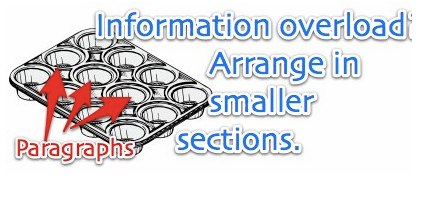 One of Aristotle's canons for writing is ARRANGEMENT. The order and "chunking" of information matters very much for reader cognition and receptivity to what you write. This care in arranging information for the audience is also part of the cognitive wedge strategy. Another way to think about this is the given-new contract to help ensure clarity and coherence for readers. Look at this discussion on Given-New. (read three pages of this).
Citation in paragraphs, here.
STRUCTURE FOR REVIEW (Paragraph by paragraphy: content in the paragraph and what you ask the paragrapg to do, in order, for the audience)
- Beginning (hook with strong opening, establish credibility of author(s), introduce context for research)
- Middle (select three or four points to share, devoting one paragraph per point)
- End (close with your commentary on application, controversy, idea for new research, and perhaps a limitation on the research)
Here is another structure guide. Can you see the stasis steops here:
Guide:
Paragraph 1: introduce, hook, establish exigence
Paragraph 2: present credibility of authors and institution; announce article by focus on topic (not title) and journal (in ITALICS)
Paragraphs 3 and perhaps 4: brief background definitions or descriptions or context
BODY PARAGRAPHS (your three or four point paragraphs)
Analysis or discusison paragraphs (1 or 2)
Conclusion
- application
- further research
- suggested reading
But, let's spend some time on stasis theory. Let's consider that many times in professional life, we need to focus on the fifth stasis of policy. WHAT OUGHT WE DO? Here is a recent document all about policy: the proposed Northern Virginia deer managment plan. You do not need to read this entire piece. However, this document came across my desk last night. I think a great deal about deer management in urban areas like ours. So, this is an example of how stasis thinking can help us with work documents. Note: nested within this document are the other stases:
- definitions
- causal patterns (deer population effects)
- plants and ecosystems
- homes and business (eating plant instations)
- safety (cars)
- human health (ticks, along with other animals, including white-footed wood mice)
- value (within the causal patterns, we can see economic and social costs)
- are white tailed deer good for our area?
- what rights to these animals have? (Consider the Bambi effect.....)
Marybeth Shea
Tasks for Thursday this week and Tuesday next week (June 21): Bottom line is that your review is due for a grade on that Tuesday at the beginning of class. You will need to bring digital copy of that assignment, to be used in a related in-class activity. More on that task on Thursday.
- For Thursday, please bring a 90% done article review to class in digital form. We will peer review, discuss your questions in class, and use the checklist.
- Use sentence strategies, as discussed.
- Consider very much how to transition between paragraphs.
- Be thinking about how to critique your article as a second-to-last step, before you conclude.
- Note: Additional short paragraphs or "connective" information is also what we will try on Thursday. For example, you may need to place small definitions near your point paragraphs or offer other content.
Resources:
- See the long post above, clicking into the links.
- (Checklist! (for your convenience but also above).
- Your article.
Are you revising the rain garden memo? If so, please complete and bring in hard copy for Thursday.